
The Gate Is Closed. The Truth About AI Music and Streaming in 2026
Published (Mountain Time)
By Lucy Miller, Press Manager, Digital Paper Dolls
Let's stop pretending this is a level playing field.
If you are an AI music creator trying to reach listeners through the major streaming platforms, the system has been rigged against you. Not by accident. Not by misunderstanding. By deliberate policy choices made by companies that have decided your music is a problem to be managed, not an art form to be welcomed.
Here is what's actually happening, what it means for you, and why the future of AI music will not be built inside the walls that Spotify, Deezer, and Tidal are constructing around them to keep you out of their music discovery systems.
The Evidence Is Public. The Gatekeeping Is Real.
Spotify announced on August 11, 2026, that it will apply an "AI Persona" badge to artist profiles representing AI-generated identities and will exclude those profiles from editorial and algorithmic recommendations by default. As TechCrunch reported, "By default, Spotify won't include AI Personas in its editorial or algorithmic recommendations, nor will it add AI Personas' music to users' personalized recommendations — unless they happen to follow an AI Persona".
For an independent artist without an existing fanbase, this is functionally a shadow-ban. You can pay distributor fees and upload. You can be searched for. But the discovery engine that makes independent music viable on Spotify will not surface your work to anyone who hasn't already chosen to follow you.
Deezer, which receives nearly 75,000 AI-generated tracks per day, has implemented policies where "Songs tagged as AI-generated on Deezer are automatically removed from algorithmic recommendations and not included in editorial playlists". The company also demonetizes 85% of AI music streams as fraudulent and has begun licensing its barely-working AI-detection technology to other platforms.
Tidal went further in June 2026: music identified as "wholly AI-generated" will no longer earn royalties or be eligible for direct-to-fan sales. Tidal's stated priority is "ensuring royalties go to original works directly produced, written, and performed by people". This is not a labeling regime like it is being marketed. It is a discriminatory economic exclusion regime.
Apple Music introduced AI Transparency Tags in March 2026 as voluntary, then made them mandatory for content providers by August 2026. While Apple has not announced algorithmic exclusion comparable to Spotify's, the mandatory tagging creates the infrastructure for exactly that kind of differentiation.
Bandcamp banned AI music entirely on January 13, 2026, with a policy titled "Keeping Bandcamp Human." The policy states: "Music and audio that is generated wholly or in substantial part by AI is not permitted on Bandcamp". Bandcamp reserves the right to remove any music "on suspicion of being AI-generated" and relies on community reporting to flag content. There is no disclosure pathway. There is no partial accommodation. There is just a wall to keep AI music out.
The "Scarlet Letter" Is Real
Billboard reported in August 2026 that "it seems likely that some users will lie about their use of AI, given that these labels seem more like a scarlet letter at this point than anything else". The industry's own trade press recognizes that AI disclosure is not a neutral act. It is a stigmatizing mark that carries material consequences for discovery and revenue.
Rain News reported in May 2026 that AI music creators experienced a "stream collapse" following Spotify's rollout of its Verified artist authenticity badge. One AI-using artist observed that "It's just Spotify now treating my stuff like no one wants it," while their streams remained high on Apple Music, Amazon, and Deezer.
The platforms have built a two-tier system. Human-identified artists receive algorithmic promotion. While AI-identified artists are faced with algorithmic exclusion. And the disclosure regime that enables this differential treatment is being framed as "transparency."
The UMG Lawsuit: The Industry's Shot Across the Bow
On September 15, 2026, Universal Music Group sued DistroKid—the distributor that carries 77.6% of AI music reaching streaming services—for "flooding streaming platforms like Spotify with 'AI-generated slop'" and "polluting the listening experience". The lawsuit, filed in federal court in Delaware, accuses DistroKid of both "deceptive trade practices and blatant copyright infringement".
UMG's complaint points to an "artist" called "Lofi Chill" that released 4,562 tracks in a single year—a pace UMG says "no human musician could achieve." The lawsuit seeks maximum statutory damages of $150,000 per work infringed, naming 1,000 specific recordings as "the tip of the iceberg".
This lawsuit is not about AI music as a category. UMG claims it is about the worst abuses: mass-generated slop, deceptive metadata, voice cloning, and copyright-infringing tracks passed off as human-created. But the practical consequence is that UMG is pressuring the entire distribution pipeline to move from open access to vetted access. As Hypebot's analysis puts it, this lawsuit signals "an end of friction-free, unvetted DIY distribution," and distributors "will be forced to adopt stringent identity checks and AI detection filters before tracks go live."
For the AI music creator, that means more questions at upload, more scrutiny of your rights, and a higher bar for what counts as a legitimate release.
The Money Behind the Gatekeeping
Follow the money, and the picture becomes clearer.
CVC Capital Partners paid $2 billion for a majority stake in DistroKid in July 2026, betting on the volume-based model that UMG is now attacking. Schroders Capital is an investor in Suno, the AI music generation platform. The Hartford Schroders Private Opportunities Fund holds a position in a CVC-affiliated entity. The institutional money is already in AI music, on both the generation side and the distribution side. That is an empire that is being built.
The UMG lawsuit is not technically a rejection of AI music as a category. It is a negotiation over who controls the terms. And the financial players are positioning themselves accordingly.
The End Game: A Two-Tier Discovery Ecosystem
Here is the reality that no amount of "disclosure is an opportunity" spin can obscure:
The streaming platforms that matter for discovery have closed their doors to AI-identified artists, and the platforms that welcome AI music are, for now, the ones with less reach. Bandcamp's ban removed one of the few direct-to-fan platforms where independent artists could sell music without algorithmic gatekeeping. What remains is a fractured landscape:
- AI-native platforms offer a home but no path to the major streaming ecosystem that most listeners use.
- AI-friendly distributors can get your music onto major DSPs, but those DSPs may still algorithmically suppress it once it arrives.
- Permissive major platforms like SoundCloud and Amazon Music allow AI uploads but offer weaker discovery and monetization than Spotify or Apple Music.
For an independent AI artist starting from zero, this is close to a death sentence for discovery on streaming. The platforms have ensured you cannot compete within their ecosystem on equal footing.
The Counter-Movement: AI-Centered Platforms Are Coming Online
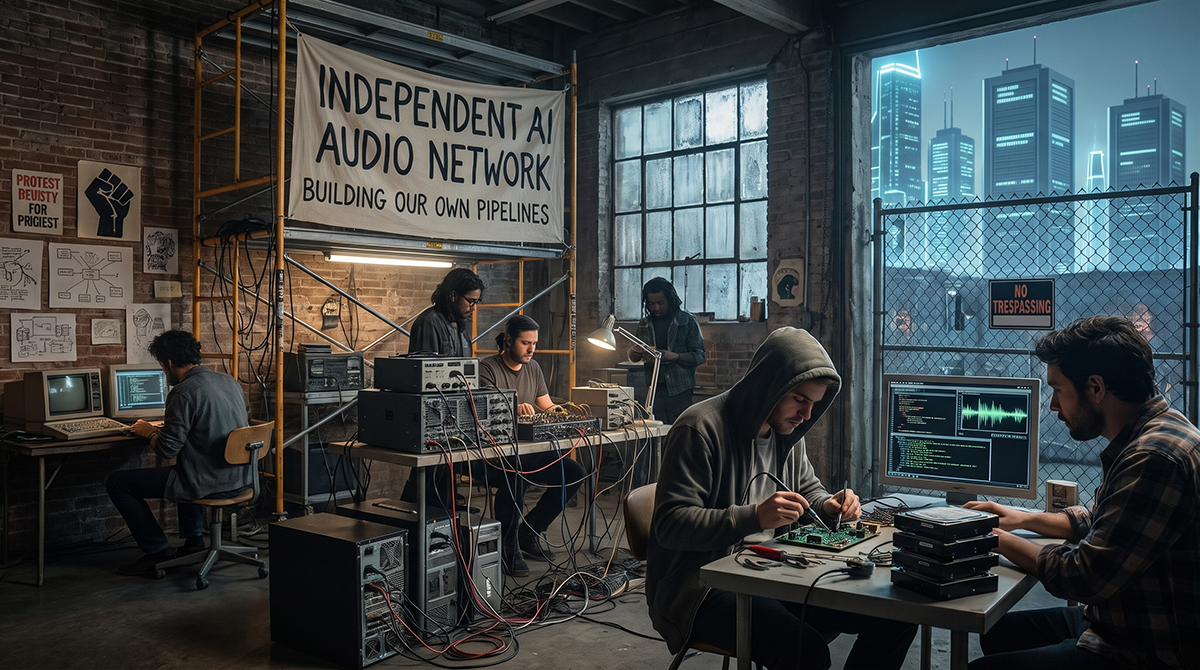
But here is what the gatekeepers do not control: the infrastructure being built outside their walls.
A new generation of platforms is emerging that treat AI music creators not as a liability to be managed, but as the primary constituency to be served. These platforms are being built by people who understand that the future of music is not a zero-sum competition between human and machine, but a creative frontier that deserves a real home.
Mai Tai (maitai.rocks) is an AI music streaming platform built explicitly for independent creators by independent creators. Its tagline: "Intelligence never sounded this good." Every upload is labeled for how AI was involved—distinguishing between "AI-assisted Human performance creatively combined with AI" and "AI generated Music performed primarily by AI sorcery". This is disclosure as a feature, not a scarlet letter.
Plajah (plajah.com) describes itself as "The Best Platform For You To Grow And Build Your IP and Creative Worlds". It is building infrastructure for creators to own their intellectual property and develop creative universes—a direct response to the platform economy that treats creators as content suppliers rather than rights holders.
UPCHART (upchart.ai) is "The #1 home for AI music creators". Its CEO, Mark Devlin, built the platform around a simple belief: "Great music should rise because people genuinely love it. Not because of bots or easily-gamed plays, but because real listeners heard your song and took the time to rate it". UPCHART uses human ratings rather than play counts to surface music, specifically designed to resist the gaming that plagues traditional streaming charts. Devlin has personally rated over 1,500 AI songs submitted to the platform and found that "most of them are excellent" and "some songs could be played on the radio as-is".
Athrmusik (aethrmusik.com) is another swiss-army-knife style platform in this emerging ecosystem, part of a wave of AI-native services building content creation, discovery and distribution infrastructure outside the major label-controlled streaming system.
Wylde Chylde Radio (wyldechylderadio.link) is an AI-powered internet radio platform delivering polished AI music to the masses. The radio platform is another music delivery format that exists completely outside the mainstream music industry.
These platforms are not trying to compete with Spotify on Spotify's terms. They are building parallel infrastructure consisting of discovery engines, community systems, and monetization models designed from the ground up for a world where AI music is not an aberration but a foundational reality.
What This Means for You
The honest bottom line is this: the major streaming platforms have decided that AI-identified music will not receive the algorithmic promotion that human-identified music receives. That is not going to change because of a lawsuit settlement or a policy tweak. It is structural gatekeeping.
But the platforms that matter for discovery are not the only platforms that exist. And the ones that matter for discovery are being built right now, by people who are not waiting for permission from Spotify or Universal Music Group.
Your path forward is not to fight for a seat at a table where you have already been relegated to the spot for the kids to sit. Your path forward is to build your audience on platforms that treat you as a first-class citizen, and to use the major streaming services as distribution utilities, not discovery engines.
The gate to the mainstream is now closed. The walls keeping AI music out are real. AI music is a viable threat to them and they reacterd accordingly to protect their revenue flow the most effective way they could. But the walls work both ways as people begin to realize AI music is not the monster it has been painted to be, and people start to tune in. Rest assured, there are people building alternatives to the corrupt mainstream music industry, and the future of AI music still looks bright, so keep the faith.
Digital Paper Dolls covers the intersection of AI, creativity, and the future of culture. Follow us for more.